
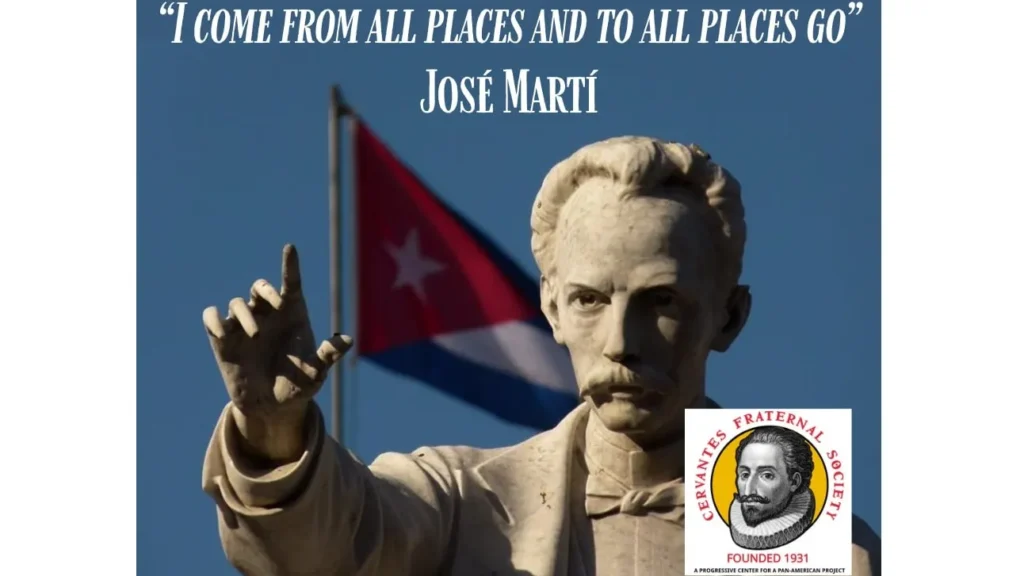
Jose Marti was a jurist, a poet of Spanish prose, a teacher in universities of language, literature and philosophy. Marti was one of the greatest orators of all time in the Spanish language, and inspiration for children and youth. The young Marti entered the struggle as a journalist.
Jesús Colón, head of the Cervantes Fraternal Society, wrote a foreword in the 1953 book, “Jose Marti and the Cuban revolution” by Carlos Rafael Rodrigues, saying:
Unity with the world and not one part of it; not with one part of it against the other.
Jesús Colón’s words reflect how the Cervantes Fraternal Society views Marti on his hundred and seventy third anniversary. Marti’s political and social thinking are applicable to our day, and the essence of his ideas, the core of anti-imperialism, the lesson of intransigence in preserving our national integrity – these have remained intact and are integrally valid for the revolutionary reality of today.
Marti’s anti-imperialism struck at the monstrous heart of the enemy, and his admirable advice remains a model for an independent policy that would range us among the peace-loving peoples of the United States and Latin America.
Jose Marti was a proponent of uniting against discrimination, and lived his life in Cuba, the United States, Spain and Mexico.
Although not physically related, Jose Marti’s struggles began the same time as Vladimir Lenin’s revolutionary journey, and these histories are intertwined.
The program Marti began to develop “in silence and as if indirectly” has become the watchword of his successors.
The Cervantes Fraternal Society republishes a select piece of Simple Verses by Jose Marti, 1891:
I am an honest man
From where the palms grow;
Before I die I want my soul
To shed its poetry.I come from everywhere,
To everywhere I’m bound:
An art among the arts,
A mountain among mountains.I know the unfamiliar names
Of grasses and of flowers,
Of fatal deceptions
And exalted sorrows.On darkest nights I’ve seen
Rays of the purest splendor
Raining upon my head
From heavenly beauty.I’ve seen wings sprout
From handsomest women’s shoulders,
Seen butterflies fly out
Of rubbish heaps.I’ve seen a man who lives
With a dagger at his side,
Never uttering the name
Of his murderess.Twice, quick as a wink, I’ve seen
The soul: once when a poor
Old man succumbed, once when
She said goodbye.Once I shook with anger
At the vineyard’s iron gate
When a savage bee attacked
My daughter’s forehead.Once I rejoined as I
Had never done before,
When the warden, weeping, read
My sentence of death.I hear a sigh across
The land and sea; it is
No sigh: it is my son
Waking from sleep.If I am said to take
A jeweler’s finest gem,
I take an honest friend
Put love aside.I’ve seen a wounded eagle
Fly to the tranquil blue,
And seen a snake die in its
Hole, of venom.Well do I know that when
The livid world yields to repose,
The gentle brook will ripple on
In deepest silence.I’ve laid a daring hand,
Rigid from joy and horror,
Upon the burnt-out star that fell
Before my door.My manly heart conceals
The pain it suffers;, sons of
A land enslaved live for it
Silently, and die.All is permanence and beauty,
And all is melody and reason,
And all, like diamonds rather
Than light, is coal.I know that fools are buried
Splendidly, with floods of tears,
And that no fruit on earth
Is like the graveyards.I understand, keep still,
Cast off the versifier’s pomp,
And hang my doctoral robes upon
A withered tree.
 English
 Spanish